
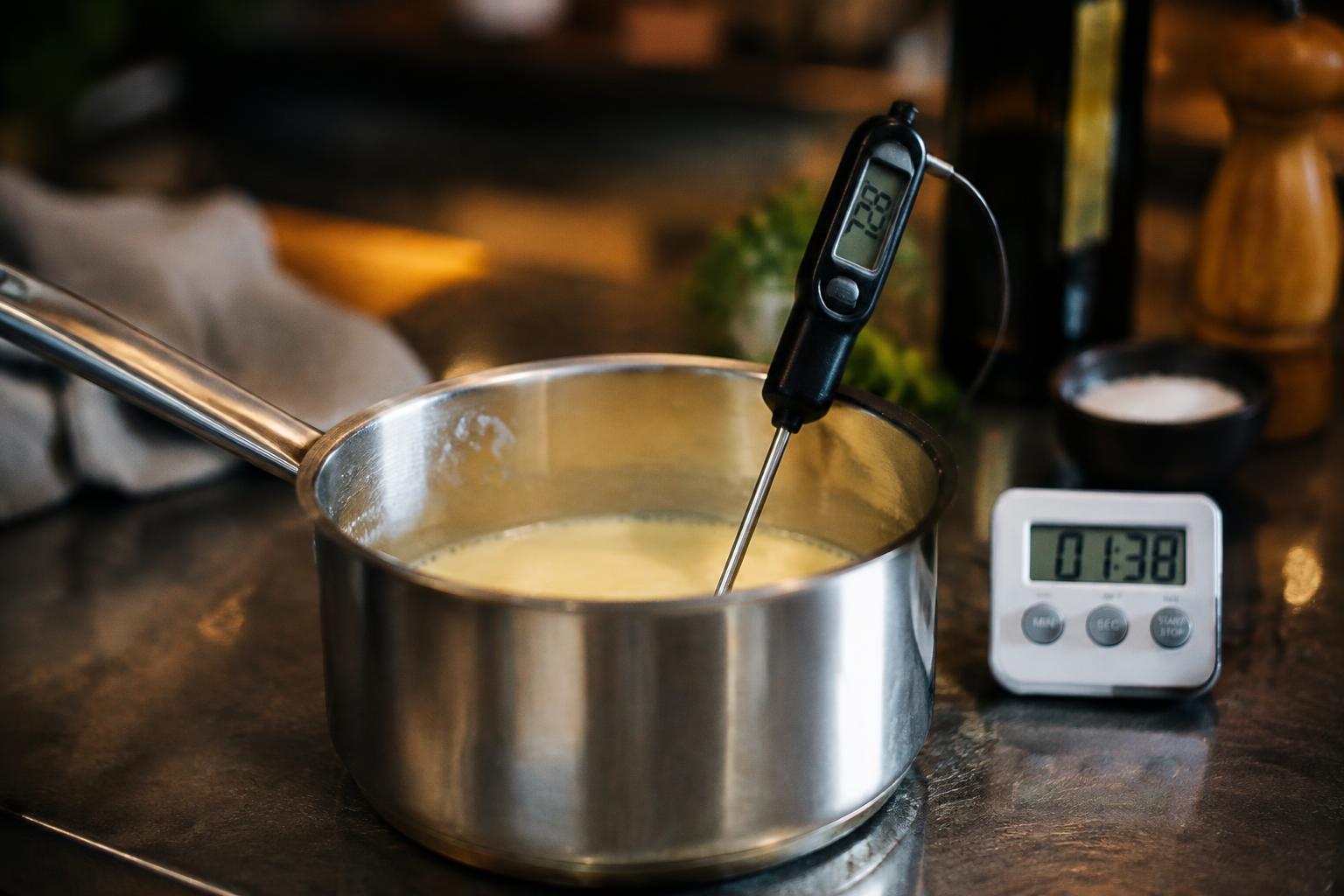
A smaller batch rarely cooks in exactly half the time: less food heats faster, while a shallow layer in a wide pan can dry out before the center is done. When you reduce a recipe, adjust for the smaller volume and watch texture, temperature, and timing closely. A half-size pot of soup, for instance, may reach a simmer well before the original recipe’s timer ends.
Key Takeaways:
- Scaling down ingredients does not reduce cooking time in the same proportion. Start checking doneness earlier, using the recipe’s visual and temperature cues rather than relying only on its original timing.
- Choose a pan that keeps ingredients at a similar depth to the original recipe. A smaller skillet or baking dish prevents thin layers from drying out before the center cooks.
- Use a kitchen scale for precise ingredient reductions, and pay special attention to small amounts of salt, spices, leaveners, and liquid. For half a recipe, weigh ingredients when dividing awkward measures such as one-third cup of flour.
Factors That Change When You Scale Down a Recipe
Reducing a recipe changes more than the amount of food in the pot: heat moves through a smaller batch differently, and the food’s contact with the pan can shift. A saucepan that suited the original quantity may leave a shallow layer, while a thick mixture in a small vessel may heat unevenly. These physical changes affect simmering, browning, and moisture loss, so the same burner setting and timing do not necessarily produce the same result.
How batch size affects pan depth and surface area
In a smaller pan, a reduced quantity often sits at a similar depth to the full batch, but the pan’s material and shape still affect how quickly heat reaches the food. If you keep the original wide skillet, the smaller amount spreads into a thinner layer, exposing more surface area to evaporation. Sauces can thicken quickly, and sautéed vegetables may brown before they soften. A narrow saucepan usually keeps liquids deeper, limiting exposed surface while concentrating heat at the base.
Why cooking time does not always shrink proportionally
Cooking time depends on the food’s thickness, starting temperature, and the rate at which the pan transfers heat, not simply on the recipe’s yield. A smaller portion of stew may reach a simmer sooner, yet a thick piece of chicken still needs enough time for its center to cook through. Use doneness cues, such as a steady simmer or a clean thermometer reading, rather than cutting the listed time by the same fraction as the ingredients.
| Cooking condition | What changes in a smaller batch | Observable effect |
|---|---|---|
| Wide skillet | Food spreads into a thinner layer | Faster evaporation and browning |
| Narrow saucepan | Liquid remains deeper | Less exposed surface area |
| Thick food | Center heats more slowly than the surface | Doneness can lag behind browning |
| Reduced liquid quantity | Simmer may begin sooner | Earlier heat and timing cues |
How to Scale Ingredients Accurately
Keep every ingredient in proportion to the others, since accurate scaling preserves the recipe’s structure, flavor, and texture. A simple conversion factor, such as reducing a batch to half, gives you a consistent starting point for each quantity. Record converted amounts before you begin, and distinguish weight from volume: 100 grams of flour is not interchangeable with 100 milliliters. Consistent units make the scaled ingredient list easier to follow.
Convert measurements and handle awkward fractions
Write each original quantity beside its converted amount, then use a kitchen scale for ingredients measured by weight. For volume measures, translate awkward fractions into a practical equivalent, such as ⅜ cup as 6 tablespoons, rather than estimating by eye. If a recipe calls for half an egg, beat the egg until the white and yolk are combined, then weigh or divide the mixture evenly. Level measuring spoons for dry ingredients.
Scale spices, leaveners, and other sensitive ingredients
Spices, salt, baking powder, and baking soda need careful scaling because small measurement errors can noticeably change flavor or rise. Reduce these ingredients in proportion to the batch, using a scale when the quantity is large enough to weigh accurately and a measuring spoon for smaller amounts. For a pinch-sized quantity, record the conversion and use a level measure rather than adding an unmeasured shake. Measure leaveners precisely, especially baking soda.
- Keep a calculator beside your recipe.
- Use grams for flour, sugar, and butter when the recipe provides weights.
- Write teaspoons and tablespoons in full to avoid unit mix-ups.
How to Adjust Equipment and Heat
Once the quantities are smaller, match the cooking setup to the reduced volume rather than relying on the original recipe’s equipment and timing. A wide pan spreads a thin layer of food across more hot surface, while a deep pot holds heat around a small batch. Pan size changes heat exposure, and burner strength affects how quickly that heat reaches the food. Choose equipment that keeps the ingredients in a suitably compact layer.
Choose a pan suited to the smaller quantity
For a reduced batch, use a skillet or saucepan that holds the ingredients without spreading them into a thin layer. Excess surface area increases evaporation and exposes more food directly to the hot base, which is especially risky for sauces, grains, and shallow braises. A close-fitting pan limits heat exposure and keeps liquids from reducing too quickly. For a small portion of scrambled eggs, a compact nonstick skillet is more suitable than a large frying pan.
| Cooking task | Better equipment fit | Heat consideration |
|---|---|---|
| Small sauce batch | Small, heavy-bottomed saucepan | Lower burner setting to limit rapid reduction |
| Reduced sauté | Skillet that holds food in a loose layer | Moderate heat prevents scorching in sparse spots |
| Small casserole | Smaller oven-safe dish | Food depth affects how quickly the center heats |
Adjust burner, oven, and cooking method
Smaller quantities often heat faster, so set the burner below the original recipe’s level, especially with thin pans that respond quickly to flame or electric coils. In the oven, a shallower or smaller dish changes heat circulation and food depth; keep the recipe temperature unless the dish or method requires a different setting. Use gentle heat for delicate mixtures, such as custards or melted chocolate, and avoid leaving a small pot over a high burner.
Tips for Preventing Overcooking
Smaller portions heat through on a different timetable, so stay near the stove or oven as the batch approaches doneness. Keep a clean fork, instant-read thermometer, and timer within reach, then use them at the point when the food looks nearly ready. Frequent checks matter most for thin pieces, shallow layers, and reduced volumes of liquid, which can move from tender to overdone quickly.
Start checking doneness earlier
Begin testing before the original recipe’s stated finish time, especially for a small pan of brownies, a single chicken breast, or a half-pot of soup. Set a timer for an earlier checkpoint, then inspect the food at short intervals rather than leaving it unattended until the full time has passed. Check before the expected finish and remove the pan from heat as soon as the center reaches the intended stage.
Use temperature, texture, and appearance as cues
For meat, insert an instant-read thermometer into the thickest part without touching bone or the pan; follow the safe temperature guidance for that food. For vegetables, test the thickest piece with a paring knife, while cakes should spring back lightly and show no wet batter in the center. Use more than one cue when appropriate, such as a browned crust and a clean skewer in a small loaf.
- Use a timer with an audible alert.
- Keep the thermometer probe clean between readings.
- Test the largest piece, not the smallest.
Common Mistakes When Downsizing a Recipe
Smaller batches change more than the quantity on your shopping list. Ingredient ratios, pan dimensions, and heat exposure interact, so a direct reduction can leave a sauce too salty or a roast dry before its center cooks through. Watch for proportion mismatches as well as timing assumptions, especially with salt, leavening, and thin portions of meat. These errors are distinct: one changes the recipe’s balance, while the other ignores how quickly a smaller portion heats.
Scaling every ingredient by the same factor
Reducing every ingredient by half is not always sound, because some components do not behave like simple portions. Halving a cake recipe’s eggs is straightforward only if you beat them and measure the required amount; cutting a pinch of baking soda or a small amount of salt exactly in half can be impractical. For soups and stews, liquid may need a different adjustment because a smaller pot loses less to evaporation. Preserve functional proportions, not just arithmetic ones.
Relying on the original cooking time
Smaller pieces and shallower layers usually heat faster, so the full recipe’s cooking time can carry a high overcooking risk. A reduced casserole in a wide dish, for instance, may finish well before the original time because the food sits in a thinner layer. Start checking early with the recipe’s relevant test: use a thermometer for meat, a skewer for baked goods, or a gentle simmer and taste for sauces. Thickness and doneness matter more than the clock.
| Mistake | What changes | Specific example |
|---|---|---|
| Uniform ingredient reduction | Some ingredients have functional roles | Measure beaten egg for a smaller cake |
| Unchanged liquid ratio | Evaporation varies with pot size | A small pot loses less stew liquid |
| Original cooking time | Thin or small portions heat faster | A shallow casserole finishes sooner |
To wrap up
Scaling down a recipe works best when you adjust more than the ingredient amounts. Use a kitchen scale for precise portions, choose a pan that keeps the food at a similar depth, and start checking doneness earlier because a smaller batch often cooks faster. Keep a thermometer handy for meat and a thin-bladed knife for cakes or vegetables. By tracking texture, temperature, and cooking time, you can bring a half-sized batch to the right finish without relying on the original timing.
FAQ
How do I scale down a recipe without overcooking it?
Start checking the food for doneness earlier than the original recipe suggests. A smaller amount may cook faster, but the timing depends on the pan’s size and shape, the heat source, and the thickness of the food.
Does halving a recipe cut the cooking time in half?
No, halving the ingredients does not necessarily halve the cooking time. Cooking time depends on how heat reaches the food, so begin checking early and use temperature, texture, or appearance to judge doneness.
What is the biggest mistake when making a smaller batch?
Relying on the original cooking time is a common mistake when making a smaller batch. Ingredient proportions and pan depth can also affect the result, so adjust quantities carefully and check doneness rather than assuming the original timing still applies.
Do I need a smaller pan when I reduce a recipe?
A pan suited to the smaller quantity can help food cook evenly and avoid spreading it too thin. Choose based on the food’s depth and the recipe’s cooking method, since a pan that is too small can also cause crowding or uneven cooking.
Is it worth scaling down a recipe for one or two people?
Scaling down can reduce leftovers and make a recipe more practical for a smaller household. It works best when ingredient amounts can be measured accurately and the cooking method still suits the smaller batch; some baked goods may need extra care because proportions affect their structure.